May is Local and Community History Month and what better way to celebrate than to highlight some of the local history groups in Birmingham.
When starting research on a particular area, the first thought is often the archives. Community Libraries in Birmingham have strong links to the local communities they serve, and some are even used as a base for local history groups to meet, share research and give talks on a variety of subjects on the history of their area.
To highlight a few in Birmingham, Acocks Green History Society sees the importance of heritage for the local area:
Heritage is an important tool at the disposal of other community forces for good. When allied with efforts to improve the environment, natural history, amenity value, infrastructure and attractiveness of an area it adds substantially to the overall energy and impact of the community’s work to improve quality of life.
Acocks Green Village after reconstruction, Birmingham, 1928. [WK/A1/89]
They have a wealth of information on the history of the area on their website, and contributed content to the Acocks Green Heritage Trail which received a grant from the Heritage Lottery Fund. From September to May, they meet once a month in Acocks Green Library – contact details are on their webpage if you want to know more!
For many Birmingham citizens in the 19th and 20th centuries, the high-end grocery shop and later department store known as Barrow’s Stores was synonymous with high quality products and high levels of customer service. Its origins are shared with those of another well-known Birmingham Quaker business, Cadbury’s which is celebrating its 200th anniversary this year.
Beginnings
Both developed from the small shop opened on Bull Street by John Cadbury on 4th March 1824 to sell ‘Fine Teas, Spices, Freshly Roasted Coffees and Cocoa’. After experimenting with grinding cocoa beans in the cellars of the shop, John decided to focus his business interests in processing cocoa and from there started what as to become renowned chocolate company, Cadbury’s. Being somewhat occupied with this other business, in 1847, John asked his nephew, Richard Cadbury Barrow, to help at the Bull Street tea and coffee shop.
Over the years our service has received many collections relating to community heritage projects. The outputs of these initiatives have enabled us to document and make available information relating to communities hitherto often neglected in the historical record – for example recent immigrants and ethnic minorities or the LGBTQ+ community. For many years content came in as physical objects like audio tapes with paper transcripts, but over the last two decades there has been a noticeable shift to hybrid or wholly digital formats.
We recently had an enquiry from an academic researcher wanting to access an archive documenting the history of pigeon racing in the region. This prompted me to look at challenges around managing, storing, and making accessible digital collections, find an immediate solution to make specific content available for them on-site, and, longer-term, widen access to the collection online via Preservica.
“Project Pigeon”[MS 4680]
The “Project Pigeon” Archive
“Project Pigeon” was founded by artists Alexandra Lockett and Ian England and ran between 2011 and 2013. Alexandra had become interested in the subject of pigeon keeping, also known as pigeon fancying, developing the archive by attending pigeon clubs, shows, and racing and training meets, learning about the care of pigeons.
A long-time staple of working-class leisure activity, pigeon keeping is especially popular in the West Midlands, with more pigeon fanciers here than any other region in Britain. Birmingham was at the forefront of innovative developments in the sport, the city’s pigeon fanciers being the first to use railways to transport the birds to distant liberation points!
Whilst not as popular as it once was, the archive reveals an interesting mix of participants in terms of age, gender, and ethnicity. The project also interviewed people engaged in associated trades including breeders and importers. The archive reveals considerable minutiae documenting working, domestic and social lives of the participants – the eldest participant was born in 1915, so was nearly 100 when interviewed!
South Birmingham racing pigeon “liberation”, 1970s [MS 4680 Acc. 2013/024]. Used with permission of Project Pigeon
Preserving and accessing “Project Pigeon” – challenges and solutions
After finding an entry on the online catalogue, the researcher made an appointment to view the archive over three days, specifically the audio and video interview recordings. Whilst paper content can be viewed here by appointment, no accessible playback versions existed of the digital master files. Processing digital archives can be fiddly and time-consuming. Fortunately, just after Christmas we had a new digital preservation workstation set up with new applications installed which made the task much easier.
I contacted the researcher to explain the situation and that I would prioritise the process of copying the interview recordings to CD. I used a new application installed on the processing workstation, Teracopy, to copy content to a suitable location on network for processing –verifying content checksums (like a digital fingerprint!) before and after copying, it provides evidence digital assets have copied without alteration or data loss.
Other challenges became apparent on analysing content using the file identification tool DROID. The audio recordings comprise solid preservation formats – Audio WaveForm – yet were often too large to fit onto CD. To resolve this, I created compressed MP3 copies using Audacity, another piece of open-source audio editing and conversion software. MP3s were added to data CDs along with the text data sheets and JPEG digital photographs (if they exist). I updated the catalogue to notify researchers surrogate copies are available.
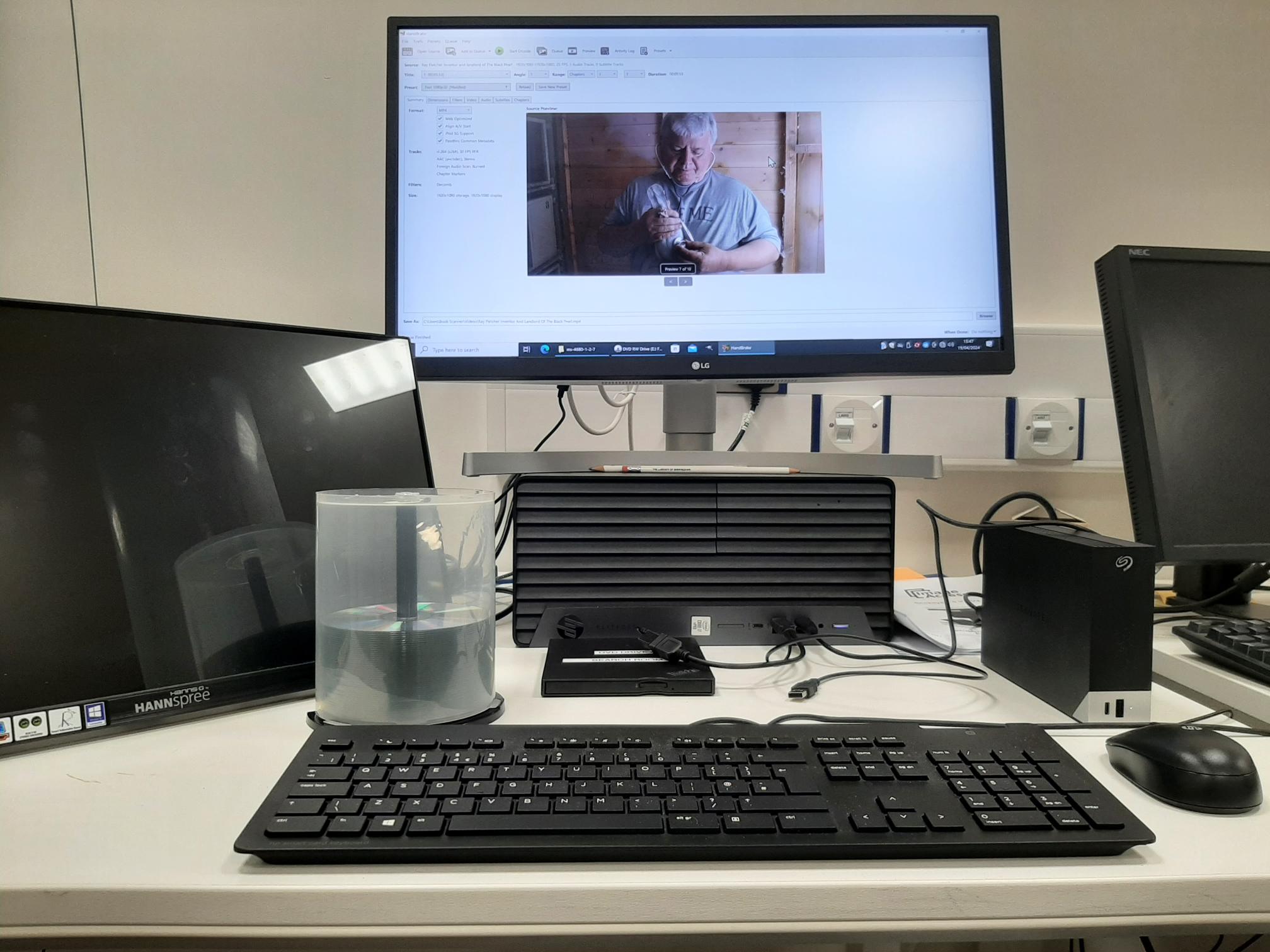
Converting video to MP4 using Handbrake software
The video content proved even more problematic, the Apple MOV files comprising multiple gigabytes of data, too large to render online or fit to DVD. Fortunately, we also have access to another open-source tool, Handbrake, which supports the conversion of video to a selection of modern, widely supported formats, including compressed web-optimised MP4s comprising a fraction of the data of the original.
Longer-term I would like to provide upload content to Universal Access, the public front end of our Preservica tenancy. Although consent forms signed by the interviewees permit us to use the archive for various purposes, including research, publication, or online display, I shall attempt to contact the depositor as a courtesy to inform them of the work I’m doing to preserve the archive and the options being considered to make this unusual collection more widely accessible, both remotely and on-site.
Setting up an Ingest Workstation
As a final note – setting up an ingest workstation can be done relatively cheaply, even by small community groups. Many of the software applications are free, open-source, and easy to use. Any real costs usually relate to hardware – PC equipment, write-blockers, USB disk drives, and the like. A useful four-part blog by Simon Wilson describes step-by-step how he set up relatively low-cost forensic workstation.
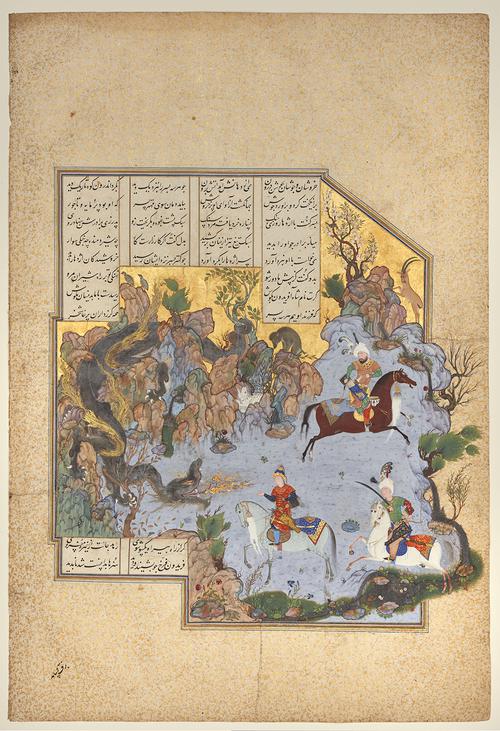
When the British arrived in India, they acknowledged the importance of the language as an official means of communication in some local provinces. Turner Macan was a British officer who was assigned as an interpreter to the commander-in-chief of the British army in 1818. Well versed in the protocol and etiquettes of courtly language, Turner was instrumental in translating the correspondence and dispatches issued by the royal court and simultaneously translated communication while dealing with local princes.
By 1820 Macan was drawn to the idea of compiling the book ‘Shahnameh,’ into a single volume. The book is 1000 years old, and its content include folklore, legends and epics glorifying Persian kings of the past. Flowery and hyperbolic terms are used to praise kings who descend on battle grounds to fight with dragon-like monsters and birds with exotic large plumages called Simurgh who act as messengers between earthly and ethereal powers. Written in verse form, the book is the longest poem ever written. What makes Shahnameh delightful is the representation of battle scenes, hunting grounds and opulent palace life in miniature paintings. Some earlier editions of the book include hand-painted illustrations of the stories. Fluid lines and intricate details in luminous patterns and colours often obtained by grinding natural ingredients became hallmark of Persian cultural artistry. The original manuscript has many editions, and none comes close to the volume first written by the Persian poet, Abul-Qasem Firdawsi.
Birmingham Dog Show 1905. Woman with Prize Dogs. [MS 3196Benjamin Stone, Box 16, Print 37]
As the annual Crufts (held last month at Birmingham’s National Exhibition Centre (NEC)) demonstrates, dogs of all shapes and sizes are generally beloved by us humans, so for National Pet Month, we thought we’d delve into our collections to see what we dog-related items we hold.
‘Dog Show’ catalogues in the stacks [L 25.4]
We have many volumes of past dog show programmes [L 25.4] in our stacks. Our oldest and longest running sequence starts from ‘Second Great Annual Exhibition of Sporting and other Dogs’, held Monday to Wednesday, 2 – 4 December 1861. These catalogues evidence that the dogs were judged in divisions (i.e., sporting and other), by sex and type of dog, and some breeds, such as the pointers, further by size. The exhibitors and their dogs are named, as are the judges.
If you cannot wait for the Easter Bunny to come, here are some tastes from the archives to keep you going until Sunday.
Barrows Stores Limited. Corporation Street, Birmingham. Bundle 3 item 36. International Cookery. Ref: LS 10/B/55/1-36 Barrows
Barrow’s stores would have had everything you need to prepare a special dinner. Above is one of their leaflets adverting some international cookery and ingredients.
Letter from Hannah Galton (Bristol) to Susannah Abrahams (Bromsgrove), 31 July 1752. Ref: MS3101/C/A/1/6/3
Perhaps you are planning a party? Would you like it to be ‘not large’, ‘very gentle’ and with ‘sillybubs?’ If so, you could try emulating Hannah Galton’s sister’s wedding fair:
‘the diner was not large but very Gentle, we had but one cours besides the desert, Except a Remove of the Top & bottom dishes which was Fish, for Venson & ducks, the desert lookd Extreamly pretty, in the midle of the Table was a Large dish of cheescakes & Tarts above & below that was 8 chenia Fruite dishes with cherries straburys Rasburys and Appricots the latter was mix’d with the cherries, on Each side was 12 chenia plates, with Jellys & Wipp Sillybubs 3 on a plate a plate of Jellys, & plate of Sillybubs was placed oposite Each other down the Table with cream intermix’d’
Extracts from Rev. Sydney Smith’s recipe for salad dressing. Ref: MS 3597/116/13 [Hutton and Beale]
If party food is not what you are after, how about a nice salad…poem? Rev. Sydney Smith has just the thing. His recipe has several ingredients, including potatoes, mustard, salt, essence of anchovy and, err, rhyme? Or, if you read the reverse, he puts the directions in ‘plain prose’ too.
Carrs Lane Chapel cookery book. Compiled in aid of the London Missionary Society. With a foreword by Mrs Leyton Richards. (Gloucester) 1934. Edited by NEWMAN (Mrs W.F.) Ref: L18.1/415777
Or maybe a dish from the Carrs Lane Chapel cookery book? This fund-raising cookbook has a good list of ‘tried and tested’ recipes. Here is the recipe for ‘Economical Haggis’ (I wonder what immoderate haggis would additionally have in?)
Two leaflets for take aways and a bakery in Birmingham. MS 2192/C/C/2/1, n.d. [1980s – 1990s]
If you are not in the mood to cook, how about some delicious takeout? These leaflets are from a file of similar items, collected by Birmingham photographer Vanley Burke in the 1980s and 1990s.
Whatever treats you partake of this week, Happy Easter from Archives & Collections
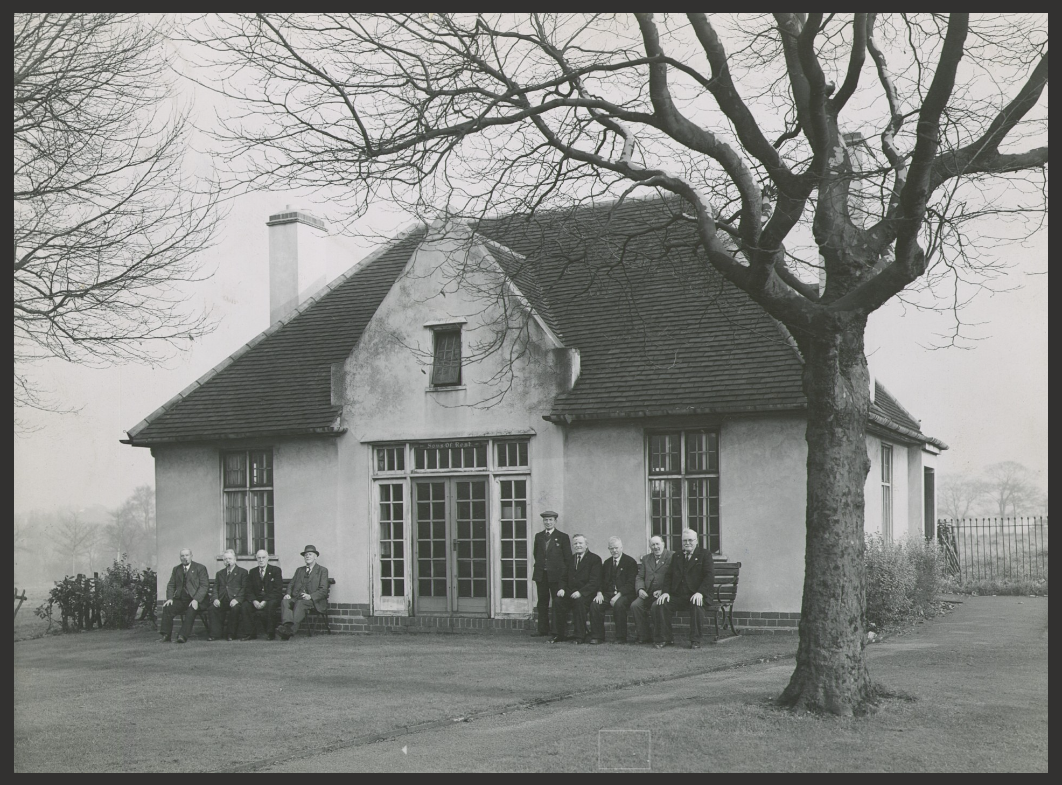
Sons of Rest, Handsworth Park, 1950s, Ref: WK/H5/557
Can any of us in 2024 really imagine the psychological impact of World War One – millions dead, many more wounded and injured physically and mentally. The understanding of the unwritten agreement between humans regards how to treat one another, completely shattered.
In the often overlooked first paragraph of Lady Chatterley’s Lover by D.H. Lawrence, first published in 1928, the voice of the narrator states – ‘Ours is essentially a tragic age, so we refuse to take it tragically. The cataclysm has happened, we are among the ruins.’ One reading of the passage could be a comment on the psychological and social aftereffects of conflict never previously seen on such a scale.
How then did individuals and the societies they lived in decide to react to the residual emotional wrench and tumult of conflict. It could be argued the Sons of Rest movement was as a direct response to the traumatic fracture of the world and the call for collective male psychological repair so much needed.
Sons of Rest, Handsworth Park, 1950s, Ref: WK/H5/555
The Sons of Rest is a social organisation formed in Birmingham in 1927 to provide leisure facilities to men of retirement age. A group of World War One veterans convened in Handsworth Park – one of the group, Lister Muff who has a plaque dedicated to him in the Handsworth Park building, put forward the proposal to start the organisation. Another, W. J. Ostler suggested the name, highlighting they had all been ‘sons of toil’ during their lives. A melding of the allusion to the biblical and the military in the name – ‘Sons Of’ inferring scripture passages referencing the Son of God. Rest referencing the euphemism employed as a mark of respect to those who did not survive the conflict – those at rest.
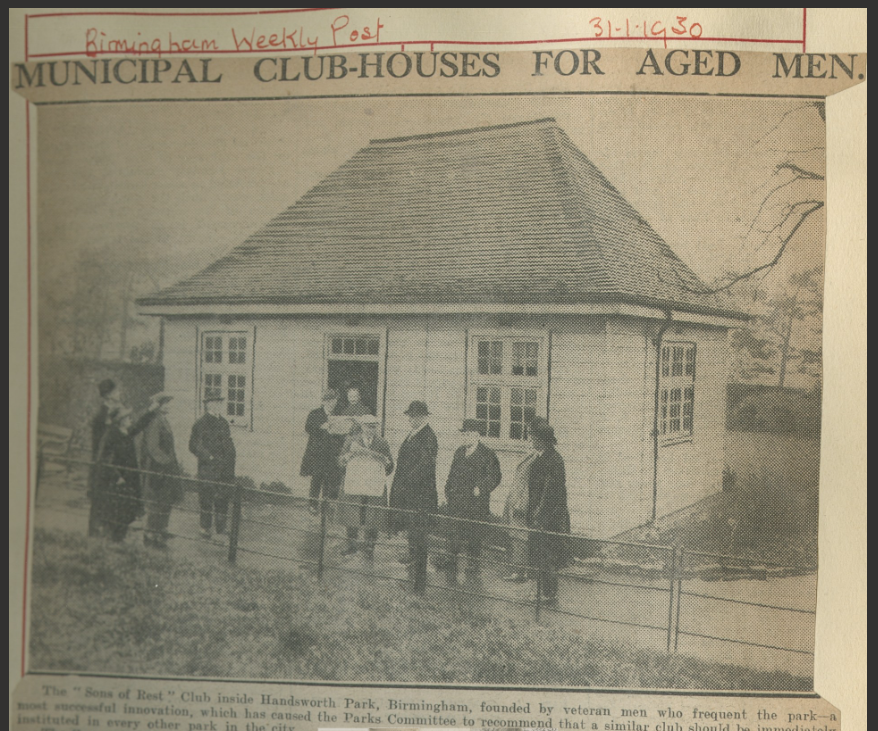
The original meeting place in Handsworth Park was an old cab driver’s shelter in the summer and the bowling pavilion in the winter. The first purpose-built building was opened in Handsworth Park in 1930 after funding appeals were made along with support from Councillor George F. McDonald, Chairman of Birmingham Corporation Parks Committee.
January 1930 Birmingham Weekly Post article
Sons of Rest premises located across Birmingham and the surrounding Black Country were typically located in the vicinity of a park or other green wooded spaces providing solace and peace. Men would gather to chat and to participate in activities such as dominoes, draughts and other board games. Latterly, several clubs extended membership to women.
WK/A1/88 : War veterans socialising in the new extension to the Sons of Rest, Broad Street Recreation Ground, Acocks Green
At its zenith, the Sons of Rest had well over 3,000 members and up to 29 premises. Several of the buildings survive and remain in use today.
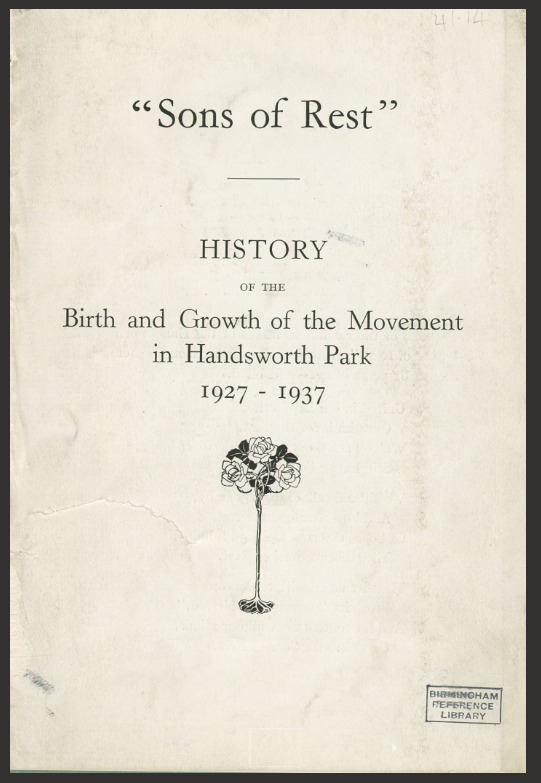
To find out more, you can read ‘’Sons of Rest’’ : History of the Birth and Growth of the Movement in Handsworth Park, 1927 – 1937 on level 4 of the library.
Image of the front cover of the pamphlet here, Ref: LP 41.14
Paul Taylor, Archives & Special Collections Co-ordinator






 The Iron Room